Search is no longer limited to a list of website links. People now ask questions in Google AI Overviews, ChatGPT, Perplexity and other AI-powered platforms and receive answers that bring together information from different sources.
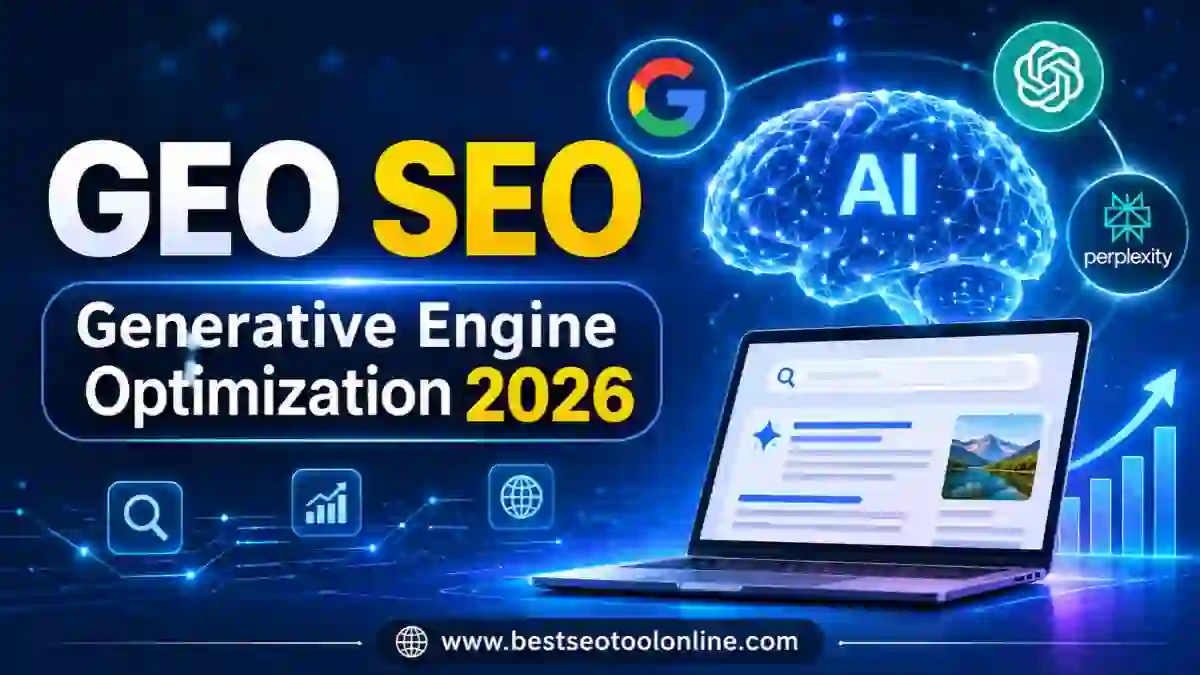
This change has created a new area of search marketing called GEO SEO (Generative Engine Optimization). Website owners are increasingly interested in how their content can become a useful source for AI-generated answers, not just how it can rank on traditional search results pages.
GEO does not replace SEO. It builds on many of the same principles: useful content, technical accessibility, clear information, relevant authority and a good experience for visitors. The difference is that businesses also need to consider how their information is understood, selected and referenced by AI-powered search experiences.
GEO SEO is the practice of improving website content, structure and credibility so that generative AI search systems can understand the information and potentially use it when answering relevant questions. It complements traditional SEO, but no technique guarantees that an AI platform will mention or cite a website.
1. What Is GEO SEO?
GEO stands for Generative Engine Optimization. It refers to improving online content so that AI-powered search and answer systems can find, understand and potentially reference it when generating responses.
Consider someone searching for “best ways to reduce website loading time”. A traditional search engine may show a list of articles, tools and service providers. An AI-powered search experience may instead provide a summarized answer, explain several methods and link to selected sources.
For a website owner, the opportunity is straightforward: publish information that answers the question accurately, explain it clearly and make the page accessible to search systems.
GEO is sometimes called AI SEO or generative search optimization. These terms are related, although their definitions are still developing. There is no universal GEO ranking formula shared by all AI platforms.
GEO does not mean writing content only for AI
A common misunderstanding is that GEO requires a completely different writing style or special content designed for machines. That is not a useful approach.
A good page should make sense to a person first. It should answer the main question, explain important details, support claims with evidence and help readers take the next step. Clear writing also makes the information easier for search systems to interpret.
2. How Does Generative Search Work?
AI-powered search platforms do not all work in the same way. Some use their own search indexes, some retrieve information from external search providers, and some combine model knowledge with information retrieved from the web.
In a typical retrieval-based search experience, the system may follow a process similar to this:
- Understand the question: The system identifies the subject, intent and details behind a user’s request.
- Find relevant information: It retrieves potentially useful pages, documents or other sources.
- Evaluate the material: It processes the information and considers how relevant it is to the question.
- Prepare a response: It generates an answer using information available to it.
- Show supporting sources: Some platforms provide links or citations to pages used in the response.
This is a simplified explanation, not a description of the exact internal process used by every platform. Retrieval methods, ranking systems and citation decisions can differ between services.
Which platforms should website owners consider?
- Google AI Overviews and AI Mode: AI-powered experiences within Google Search.
- ChatGPT Search: ChatGPT’s search experience, which can provide links to web sources.
- Perplexity: An answer-focused search platform that commonly displays supporting citations.
- Microsoft Copilot: Microsoft’s AI assistant and search-related experiences.
- Gemini: Google’s AI assistant, with capabilities that vary by product and context.
Being visible on one platform does not guarantee visibility on another. Each service has its own systems and may return different sources for the same question.
3. SEO vs GEO vs AEO: What Is the Difference?
SEO, GEO and AEO are connected, but they describe different areas of search visibility.
| Approach | Main purpose | Example |
|---|---|---|
| SEO | Improve visibility in traditional search engine results. | Ranking a service page for “SEO agency in Hyderabad”. |
| AEO | Make content useful for direct answers and question-based search experiences. | Providing a clear answer to “What is technical SEO?” |
| GEO | Improve the chances of content being understood and referenced in generative AI responses. | Publishing a detailed guide that an AI search platform may cite when explaining technical SEO. |
These activities overlap. A well-organized article with a clear answer, relevant evidence and good technical SEO can support all three. There is no need to create three separate versions of the same article.
4. Why GEO Matters for Businesses
Search behaviour is changing. Instead of opening several pages, some users prefer to ask a detailed question and read a summarized response. Others use AI search to compare products, understand services or shortlist companies.
This creates a reason for businesses to review how their information appears across search experiences.
Visibility beyond traditional rankings
A business may have useful information that does not always appear in the first few traditional search results. If an AI platform retrieves and cites that page for a relevant question, the website may receive exposure through a different search experience.
More informed potential customers
Someone researching a service may ask an AI platform about pricing factors, common problems, available solutions and questions to ask a provider. Businesses that publish clear, trustworthy explanations can help people understand these topics before contacting them.
Brand credibility
Being mentioned or cited by a search platform can introduce a business to people who may not have discovered it through a normal keyword search. However, an AI mention is not automatically an endorsement, and it should not be treated as proof of business quality.
5. Practical GEO SEO Strategies to Improve AI Search Visibility
The most useful GEO work often begins with improving existing website content rather than publishing dozens of new articles. Review the pages that already attract visitors, explain important services or demonstrate your expertise.
1. Answer the main question early
Readers should not have to scroll through several paragraphs to understand what a page is about. Start with a direct explanation of the subject and then provide supporting detail.
For example, an article targeting “What is local SEO?” should explain local SEO in its opening section before discussing its history, tools or advanced strategies.
2. Cover the topic properly
A useful article answers the main question and the related questions a reader is likely to have. For a guide about website speed, that may include Core Web Vitals, image optimization, caching, hosting and how to test performance.
Do not add unrelated headings just to increase word count. Include a section only when it helps the reader understand the subject or make a decision.
3. Use specific headings
Headings should describe the information that follows. “How to improve website speed” is more useful than a vague heading such as “Important things to know”.
Organize the page with one main H1, relevant H2 sections and H3 subsections where necessary. This also makes longer articles easier to scan.
4. Add original information
Rewriting the same points found on ten competitor websites will not give readers much reason to visit your page. Add something that comes from your own work.
Depending on your industry, this could include:
- Observations from real website audits.
- Original screenshots showing a process or result.
- Examples from projects, with client permission where needed.
- Comparisons based on your own testing.
- Common mistakes you have actually encountered.
- Clear explanations of why you recommend a particular approach.
5. Support important claims with reliable sources
If an article includes statistics, technical requirements or claims about a platform, link to the original source whenever possible.
For example, Google’s Search Central documentation is a better reference for Google Search requirements than an unsupported claim from a random marketing blog.
Check the date of research before using statistics. A figure from an older study should be identified by its publication year rather than presented as a current measurement.
6. Build clear author and business information
Readers should be able to understand who created the content and why they should trust it. Maintain an author profile that includes relevant experience, areas of expertise and links to genuine professional profiles.
Businesses should also maintain accurate contact information, service descriptions, company details and relevant customer information across their website.
7. Strengthen internal linking
Connect related pages using descriptive anchor text. Internal links help readers discover related information and help search engines understand the structure and relationships between pages on your website.
For example, if you are learning about SEO tools and backlink building, you can explore our practical guide to the YouTube Backlink Generator. It explains how YouTube backlinks work and how to approach backlink creation for video content.
Similarly, an article about GEO SEO can link to relevant guides about technical SEO, keyword research, content strategy and website audits. Use links where they genuinely help readers, rather than adding them just to increase the number of internal links.
8. Use tables where comparisons are useful
Tables are useful for explaining differences between tools, methods, pricing factors or technical concepts. Keep them readable on mobile devices and avoid placing an entire article inside a table.
9. Add relevant images and diagrams
Use screenshots, original diagrams and photographs when they explain something better than text alone. Give images descriptive file names and meaningful alt text. Do not add decorative images simply to make a page look longer.
10. Keep important information accessible
The main article should be available as readable page content. Do not hide essential explanations behind interactions that prevent users or search systems from accessing them.
11. Update outdated information
AI search, search engine features and digital marketing tools change over time. Review important articles periodically. Correct outdated instructions, replace old statistics and update examples when the underlying facts change.
12. Make the page genuinely useful
A visitor should leave with a better understanding of the subject or know what to do next. If the page simply repeats a definition and several generic tips, it needs more substance.
6. Technical SEO Requirements for GEO
Good content cannot perform well in search if the page has serious crawling, indexing or rendering problems. Technical SEO remains an important part of a GEO strategy.
Check whether search engines can access your pages
Review your robots.txt file, page-level robots directives, canonical tags and server configuration. Make sure that important pages are not accidentally blocked.
Understand AI crawlers
Some AI services use crawlers to discover or retrieve web content. OpenAI, for example, documents separate crawlers for search-related discovery and model training.
The OAI-SearchBot crawler is used for ChatGPT search discovery, while GPTBot is associated with crawling content that may be used for model training. These controls are independent. Website owners should understand their purposes before changing robots.txt rules.
Allowing a crawler does not guarantee that a page will be cited or displayed in an AI answer.
Use structured data correctly
Structured data gives search engines additional context about a page. For an editorial guide, appropriate Article or BlogPosting schema can identify the headline, author, publication date, modification date and representative image.
Keep structured data consistent with the information visitors can actually see on the page. Do not add invented authors, dates, reviews or ratings.
Schema markup is useful for describing content, but it is not a special GEO ranking switch. Google states that no special schema markup is required for AI Overviews or AI Mode.
Technical checklist
- Important pages return a successful HTTP response.
- Search engines can crawl the required content.
- Pages intended for search are not accidentally marked noindex.
- Canonical URLs are correct.
- Important content is available as readable text.
- Mobile pages are easy to use.
- Images have descriptive alt text.
- Internal links point to relevant pages.
- Structured data matches visible page content.
- The XML sitemap contains the correct canonical URLs.
- Google Search Console is configured and monitored.
7. A Practical GEO Content Optimization Example
Consider a digital marketing agency that wants its website to attract businesses looking for SEO services.
A basic service page might contain a headline, a short paragraph about SEO and a contact form. It may explain what the agency offers, but it does not answer many of the questions a potential customer has before choosing an agency.
A more useful page would explain the service in greater detail.
| Basic service page | More useful service page |
|---|---|
| We provide professional SEO services. | Explain the SEO services offered, the type of businesses served and the problems each service addresses. |
| We help businesses grow online. | Explain the work involved, such as technical audits, content improvements, keyword research and local SEO. |
| Contact us for pricing. | Explain the factors that influence pricing, such as website size, competition, location and project scope. |
| We are experienced professionals. | Show genuine team experience, relevant projects, case studies and verifiable credentials. |
| Get in touch today. | Provide clear contact details, service locations, consultation options and next steps. |
The second page gives potential customers more useful information. It also provides search systems with clearer context about the agency, its services and the questions it can answer.
This is a practical content improvement, not a promise that an AI platform will cite the page. The result should be evaluated through actual search visibility, user engagement and enquiries.
How to document a real GEO case study
If you are conducting GEO work for a client, record the starting position before making changes. Choose a fixed set of relevant questions and check how often the website appears as a cited or linked source across the platforms you are studying.
Record the date, platform, exact question, response, cited URLs and any changes made to the website. Repeat the same checks after optimization.
This creates a transparent case study based on observations. Do not claim that a particular content change caused an improvement unless your evidence supports that conclusion.
8. How to Measure GEO SEO Performance
Traditional SEO reporting often focuses on rankings, organic traffic and conversions. GEO reporting needs to consider these metrics alongside the visibility of a website in AI-generated answers.
| Metric | What it tells you | How to track it |
|---|---|---|
| AI citations | How often a platform links to your website as a source. | Record citations from a consistent set of test questions. |
| Brand mentions | Whether your business is named in relevant AI answers. | Monitor responses and distinguish linked mentions from unlinked mentions. |
| Referral traffic | Visits arriving from AI platforms. | Review referral sources in analytics tools. |
| Organic traffic | Visitors arriving through traditional search results. | Use Google Search Console and website analytics. |
| Conversions | Whether visitors become leads, enquiries or customers. | Track calls, forms, purchases and other business goals. |
| Content performance | Which pages attract impressions, clicks and useful engagement. | Review page-level search and analytics reports. |
Why manual AI visibility checks need consistency
AI answers can change depending on the wording of a question, the date, location, account settings and the platform’s retrieval process. A single test is not enough to establish a reliable trend.
Use the same questions, platforms and checking process over time. Keep a record of the exact prompt and the date of each test. Treat the results as observations rather than a guaranteed ranking report.
9. Common GEO SEO Mistakes to Avoid
- Publishing content only to target AI: Articles still need to serve real readers.
- Repeating competitor content: A slightly rewritten version of another website does not provide much original value.
- Keyword stuffing: Repeating “GEO SEO” unnaturally can make the page difficult to read.
- Adding unnecessary schema: Use structured data that accurately describes the page.
- Blocking crawlers without understanding them: Check what each crawler is used for before changing access rules.
- Buying artificial mentions: Inauthentic brand mentions and manipulative link schemes are not a reliable way to build trust.
- Inventing case studies: Do not publish made-up traffic improvements, client results or AI citations.
- Ignoring traditional SEO: Crawlability, indexing, internal links and helpful content remain important.
- Expecting immediate results: Search visibility can take time and is never guaranteed.
10. A Practical 30-Day GEO SEO Action Plan
You do not need to rebuild an entire website to begin. Start with a small number of important pages and make improvements that can be measured.
| Period | Tasks | Expected output |
|---|---|---|
| Days 1–7 | Review important pages, identify search intent, check indexing and document current AI visibility for relevant questions. | A list of priority pages and a baseline report. |
| Days 8–14 | Improve introductions, headings, explanations, original examples and internal links. | More useful and clearly structured content. |
| Days 15–21 | Review technical SEO, page speed, crawler access, canonical tags and relevant structured data. | Fewer technical barriers and more accurate page information. |
| Days 22–30 | Recheck the selected AI questions, review Search Console and analytics data, and document changes. | An initial performance comparison and next-step plan. |
The purpose of this plan is to establish a repeatable process. Thirty days is a useful starting period for implementation and measurement, not a promise of rankings or AI citations within that time.
11. Frequently Asked Questions About GEO SEO
What does GEO SEO stand for?
GEO stands for Generative Engine Optimization. It refers to improving website content and accessibility so that generative AI search platforms can understand the information and potentially reference it in their answers.
Is GEO SEO different from traditional SEO?
Yes, although the two overlap. Traditional SEO focuses on visibility in search engine results, while GEO considers how content may be discovered and used in AI-generated answers. Strong SEO fundamentals support both.
Does Google require GEO-specific schema markup?
No. Google states that there is no special schema markup required for AI Overviews or AI Mode. Use structured data where it accurately describes your page and supports relevant search features.
Can a new website appear in ChatGPT or Perplexity?
It is possible, but there is no guaranteed route. The website needs accessible, useful information that is relevant to the question. Discovery, retrieval and citation depend on each platform’s systems.
Does publishing more articles improve GEO visibility?
Not automatically. Publishing more pages is useful only when those pages provide distinct value. A smaller collection of detailed, accurate and original resources can be more useful than a large collection of repetitive articles.
Is AI-generated content bad for Google SEO?
The use of AI does not automatically make content ineligible for Google Search. The important issue is whether the content is useful, original and created for people. Producing large amounts of unoriginal content primarily to manipulate rankings can violate Google’s spam policies.
How long does GEO SEO take to show results?
There is no fixed timeline. It depends on the website, content quality, technical condition, competition and the platforms being measured. Track changes over time rather than expecting a guaranteed result within a specific number of days.
How can I check whether ChatGPT mentions my website?
Create a list of relevant questions that potential customers might ask. Test them consistently in the search-enabled experience, record whether your brand or website appears, and note any source links. Repeat the checks over time because answers can vary.
12. Final Thoughts
GEO SEO is worth understanding because people are using more than traditional search results to find information. But businesses do not need to abandon the SEO practices that already help their websites.
Start by improving the pages that matter most. Answer questions clearly, demonstrate real expertise, use trustworthy references, maintain a technically accessible website and explain your services honestly.
Then measure what happens. Look at organic search performance, referral traffic, enquiries and whether relevant AI platforms cite your content. Use those observations to decide what needs improvement.
The strongest long-term approach is not to chase every new AI search feature. It is to build a website that consistently provides information people can understand, verify and use.
References and Further Reading
The following official resources are useful for checking current search guidance, AI search features, structured data and crawler policies.